
METIS - the Mid-Infrared ELT
Camera and Spectrograph
Abstract: With a primary mirror diameter of 39 metres, the European Southern Observatory's Extremely
Large Telescope (ELT), the largest optical telescope in the world, will go into operation at the end of the
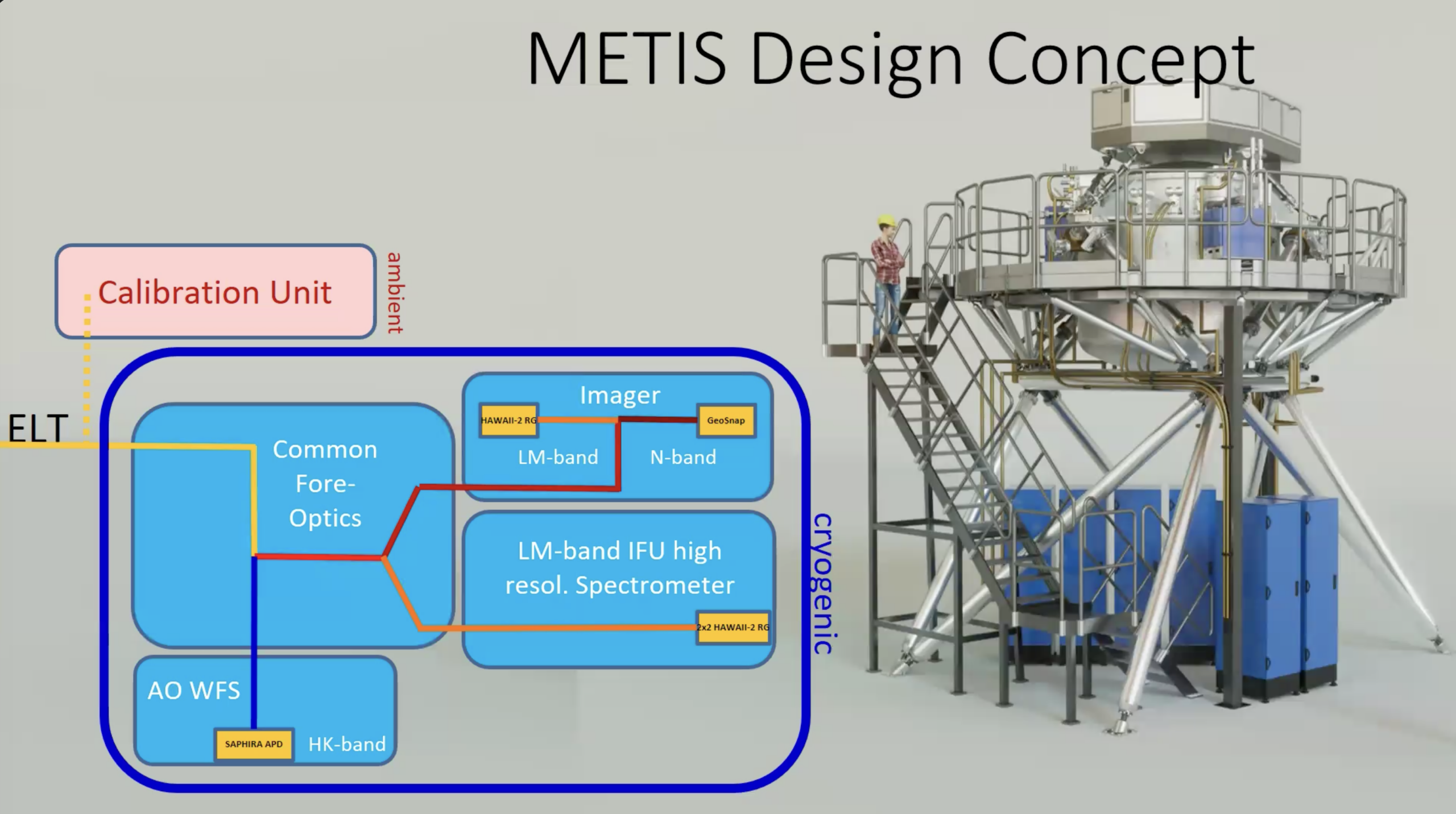
decade. METIS, a combination of a camera and spectrograph for the mid-infrared, will be one of the very
first instruments for the giant telescope. The scientific objective focuses on the immediate vicinity of stars, in
particular the processes taking place there during their formation, as well as the formation of planets in
young circumstellar discs. The detection and characterisation of older exoplanets is also one of the core
tasks of the instrument. Such observations require very high resolution and high contrast, which is facilitated
on the one hand by the combination of the very large aperture with the relatively large wavelengths, but on
the other hand requires high-precision control and correction of the incident light wavefronts by a
sophisticated adaptive optics system. The combination of adaptive optics, cameras and spectrographs, as
well as the effort required to cool the instrument to well below 100 Kelvin due to the long observation
wavelengths, results in enormous complexity and high overall costs. The presentation will cover the
development of METIS from concept to its current state. I will outline the path from the scientific objectives
to the resulting requirements and present the optimised technical solutions, with a particular focus on
explaining how adaptive optics work. Finally, I will show the current state of the instrument at the various
consortium sites.