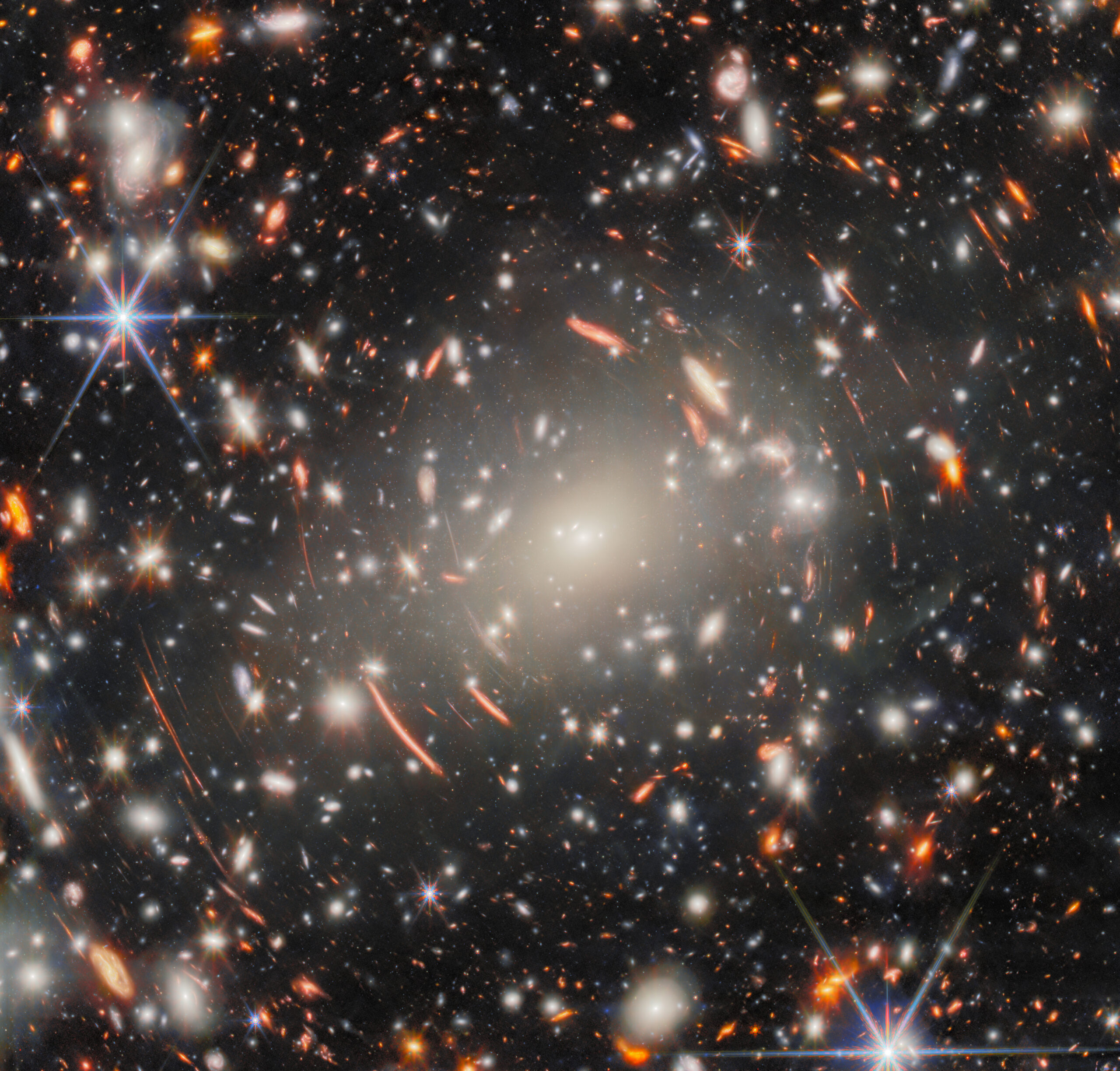
(Image: SA/Webb, NASA & CSA, H. Atek, M. Zamani, R. Endsley).
Until now, our understanding of the reionisation era – when the first stars illuminated and ionised the gas in the Universe – has relied on the brightest galaxies, which account for only 1 to 10 per cent of all galaxies. This study, entitled ‘A Glimpse of the 99%’, delves for the first time into the remaining 99 per cent: the so-called faint galaxies. By using the Abell S1063 galaxy cluster as a gigantic natural magnifying glass (via a phenomenon known as gravitational lensing), the team of researchers was able to amplify the light from extremely distant sources. This technique enabled a record observational depth to be achieved (Muv = –12 mag), approximately three magnitudes deeper than was previously possible with the Hubble Space Telescope.
Contrary to some theoretical predictions, the number of very faint galaxies continues to grow rapidly as luminosity decreases. No slowdown in this trend was observed in this study. Current models of galaxy formation predicted an early and gradual decline in these small structures due to stellar feedback (galactic winds or supernova explosions). However, these new JWST data show that these galaxies are far more resilient than expected, prompting us to revisit models of star formation suppression.
Although these galaxies are puny individually, they are so numerous that they dominate the total emission of high-energy radiation and are primarily responsible for the reionisation of the Universe. They provide enough ionising photons to keep the Universe transparent, even under conditions of very dense intergalactic gas. Their abundance also suggests that a tiny proportion of the radiation escaping from these galaxies is sufficient for reionisation. If this fraction were higher, this process would have occurred much earlier than measurements of the cosmic microwave background indicate.
The GLIMPSE programme is a programme of ultra-deep observations carried out using the JWST’s NIRCam instrument. It focuses on using gravitational lenses to probe the far reaches of the early Universe, providing the deepest images ever obtained to date.
Further information
- Sorbonne University press release
- CNRS Terre & Univers press release
- Reference for the scientific article
ATEK, Hakim ; CHEMERYNSKA, Iryna ; FURTAK, Lukas J. ; RICHARD, Johan ; CHISHOLM, John ; KOKOREV, Vasily ; JECMEN, Michelle ; KORBER, Damien ; ENDSLEY, Ryan ; PAN, Richard ; BASU, Arghyadeep ; BLAIZOT, Jérémy ; BOUWENS, Rychard ; EZZIATI, Meriam ; HEURTIER, Sylvain ; McQUINN, Kristen B. W. ; MUN, Marcie ; MUNOZ, Julian B. ; OESCH, Pascal ; ROSDAHL, Joakim ; SALDANA-LOPEZ, Alberto ; FUJIMOTO, Seiji. A GLIMPSE of the 99%: a census of the faintest galaxies during the epoch of reionization and its implications for galaxy formation models, 2026, Open Journal of Astrophysics. https://doi.org/10.48550/arXiv.2604.23823